


Faculty of Letters
The Faculty of Letters is devoted to accumulating the wisdom of mankind in the area of cultural and social matters, and carrying out in-depth research and thorough education in the specialized areas of language, literature, history, and cultural assets as well as striving to develop new fields of research and education as an intellectual base to respond to the various issues brought up by modern and regional society. Furthermore, we also cultivate useful human resources that can respond to regional culture and issues, and contribute to the international society by providing students with a wide range of knowledge, rich humanity, high-level expertise, and a comprehensive perspective through ongoing research and education.
Departments
| Department of Japanese and Chinese CUltures | In the Department of Japanese and Chinese Literature, students study Japanese linguistics, Japanese literature and Chinese literature in their relation to each other. |
|---|---|
| Department of Intercultural Studies | In the Department of European and American Linguistic Cultures, students study European and American linguistic cultures, the English language, English education studies, Japanese-English translation culture, and international cultural exchange. |
| Department of Historical Studies | In the Department of Historical Studies, students study the historical progress of society, culture and philosophy of the world, centering on the culture of Japan. |
International Kyoto Studies Program
The Faculty of Letters offers the International Kyoto Studies Program as a core, compulsory curriculum for all students. The program is designed to develop global-minded professionals who can contribute to Kyoto's local society and promote international exchange in culture and education. Through this curriculum, students cultivate a broad global outlook, deep academic knowledge, and exceptional research skills.
To complement the program, our four departments offer a rich selection of interdepartmental courses, lectures, seminars, and hands-on fieldwork. These include specialized courses such as Introduction to International Kyoto Studies, as well as focused seminars in Documentary Studies, Kyoto Culture, Cultural Heritage Policy. Students can also participate in the Study Program for World Cultural Heritage Sites—a study-abroad experience in Germany or Australia that includes thorough domestic preparatory training before departure.
The Faculty of Letters offers the International Kyoto Studies Program as a core, compulsory curriculum for all students. The program is designed to develop global-minded professionals who can contribute to Kyoto's local society and promote international exchange in culture and education. Through this curriculum, students cultivate a broad global outlook, deep academic knowledge, and exceptional research skills.
To complement the program, our four departments offer a rich selection of interdepartmental courses, lectures, seminars, and hands-on fieldwork. These include specialized courses such as Introduction to International Kyoto Studies, as well as focused seminars in Documentary Studies, Kyoto Culture, Cultural Heritage Policy. Students can also participate in the Study Program for World Cultural Heritage Sites—a study-abroad experience in Germany or Australia that includes thorough domestic preparatory training before departure.
Field Programs
| Field Seminar of Kyoto Culture Studies | Visiting historical sites which are recognized as the essence of Kyoto, students experience the stories of classical literature such as The Tale of Genji, The Tale of the Heike and others based on specialized instruction. |
|---|---|
| Study Program for World Cultural Heritage Sites I, II | These are study programs for language and culture in Sydney, Australia or Regensburg, Germany. With the field study of the World Cultural Heritage sites, students deepen their understanding of a different culture and acquire the ability to give a presentation on the subject. |
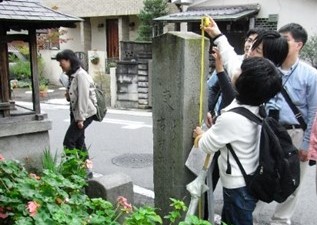
| Field Seminar of International Kyoto Studies | Through field investigations of the cultural assets in Kyoto, students gain a deep understanding the history and learn how to preserve, utilize and convey the information of those cultural assets. |
Contact point